
INDIAN YOUTH AWARENESS PROGRAM
Discussing Tibet and Why Tibet Matters to India?
Project/Program Name: Indian Youth Awareness Program
Date of Activity: 10th February-9th March 2026
Venue: Four Indian Colleges & Institutions
Reported by: Ngawang Paldon (Project Officer)
Total Participant/Beneficiaries: 420 Participants
Objective of the Program:
The central aim of this awareness tour is to educate Indian youth about the Tibetan people’s nonviolent resistance to the Chinese occupation while highlighting Tibet’s enduring relevance to India. Through engaging presentations, ANEC will bring the Tibetan story to life—emphasising resilience, justice, and nonviolent struggle. The initiative will help students better understand the Sino-Tibetan conflict and reflect on why Tibet matters to India, while underscoring the significance of the Indo-Tibetan relationship.
By engaging with India’s future leaders, ANEC hopes to foster greater empathy, solidarity, and critical thinking regarding Tibet’s plight. We aspire to create a lasting connection between the Tibetan cause and the younger generation in India, grounded in shared values of nonviolence, compassion, and human rights. Our goal is to build a supportive community in India that recognises Tibet’s struggles as an important and shared concern for peace and justice.
Resource Persons:
Ngawang Paldon (Project Officer)
Tsering Sonam (Project Officer)
Activity Overview:
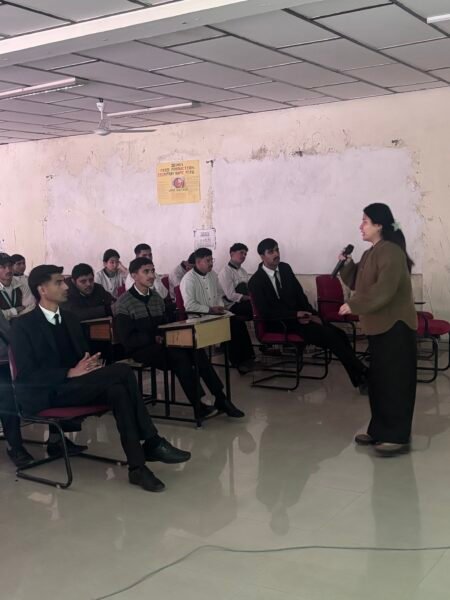
- The session began with an introduction to the organization by the Project Officer, Ngawang Paldon, accompanied by the screening of an introductory video.
- The first part of the presentation covered Tibet as a historically independent nation, followed by a brief overview titled “Tibet at a Glance.”
- A key highlight of the first half was the segment “From Independence to Annexation,” which explained how Tibet was occupied by China under the pretext of liberalization. In the second half of the presentation, Tsering Sonam addressed Tibet under the rule of the Chinese Communist Party (CCP), emphasizing the current situation inside Tibet.
- Attention was then drawn to the topic “Why Tibet Matters to India,” presented by Tsering Sonam, supported by a powerful video and further explanation.
- The presentation concluded with a reflective question, “What can you do for Tibet?” followed by the facilitators expressing their deepest gratitude to the people and Government of India on behalf of the Tibetan people.
- The session ended with a heartfelt tribute song dedicated to India and a meaningful Question and Answer segment.
Methodology:
- A PowerPoint presentation on “Why Tibet Matters to India?” was used as a key tool to convey the message effectively.
- Carefully selected videos were screened to enhance participant engagement and interest.
- A Question & Answer session was conducted to encourage meaningful dialogue and deeper discussion.
Lesson learned or Challenges Encountered:
- The most challenging aspect was reaching out to universities and waiting for their
approval to conduct a one-hour session at their respective institutions.
- The original plan for the “Indian Youth Awareness Program” was to hold it in Central
India in collaboration with Mr. Yash; however, due to unforeseen challenges, the
program location had to be changed.
- The number of students promised to attend was affected due to sudden changes in
the universities’ schedules.
Number of students at different institutions:
- State Institute of Hotel Management – 83
- Gian Jyoti Bachelor Institute- 128
- Rajiv Gandhi Government Engineering College – 162
- Mehr Chand Mahajan Multi Skill Training Institute- 47
Total Number of Students- 420 Students